
You shower every single day. Maybe twice. You use a body wash that promises 24-hour freshness. And somehow, by mid-afternoon, the odour is already creeping back. Sound familiar?
Here’s something that might surprise you: the problem probably isn’t your hygiene. It’s your skin’s microbiome, and there’s a good chance your body wash is actively making things worse.
Let me explain what’s actually going on.
Contents
Wait, so sweat doesn’t cause body odor?
Not directly, no. This is probably the biggest misconception in personal care. Sweat itself is almost completely odourless when it first leaves your body. The smell comes from bacteria on your skin breaking down the compounds in sweat and producing odorous byproducts as a result.
Your skin has two types of sweat glands worth knowing about. Eccrine glands are spread across your whole body and produce the thin, watery sweat you get when you exercise or overheat. Apocrine glands are concentrated in your armpits and groin and produce a thicker, protein-rich secretion. That apocrine sweat is what odour-causing bacteria love to feed on.
The specific bacteria responsible are mainly Staphylococcus hominis and Corynebacterium species. They metabolise compounds in apocrine sweat into volatile molecules, and those molecules are what you actually smell. The more of these bacteria relative to everything else on your skin, the more intense the odour.
This is also why two people with the exact same hygiene routine can have wildly different experiences with body odour. It comes down to the composition of the microbial community on your skin, not how often you shower.
What is the skin microbiome and why does it matter?
Your skin microbiome is the community of bacteria, fungi, and other microorganisms living on your skin’s surface. I know that sounds a bit unpleasant, but the vast majority of them are either harmless or genuinely good for you. They help maintain your skin’s pH, compete with harmful bacteria for space, and support your skin’s natural immune function.
When this community is balanced, odour-producing species are kept in check. When it gets disrupted, a state called skin dysbiosis, the odor-causing bacteria get the upper hand and the smell intensifies.
Your skin’s surface has a naturally acidic pH of roughly 4.5 to 5.5, known as the acid mantle. This slightly acidic environment is inhospitable to many odour-producing bacteria but perfectly comfortable for the beneficial ones. Use something that disrupts this pH repeatedly and you shift the balance on your skin in ways that work against you.
Can your body wash actually make body odour worse?
Yes, and honestly, this is the part the big body wash brands would rather you didn’t think too hard about.
Most mainstream body washes use sulphate-based surfactants like sodium lauryl sulphate (SLS) or sodium laureth sulphate (SLES) as their main cleansing ingredient.
These are incredibly effective at stripping away oil, dirt, and bacteria. The problem is they don’t discriminate. They strip your skin’s natural oils, raise your skin pH above that protective acidic range, and wipe out beneficial bacteria right alongside the harmful ones.
You step out of the shower feeling squeaky clean. But what’s happening underneath the surface is that your skin microbiome has been flattened. And moreover, odor-producing bacteria tend to repopulate faster than the beneficial species after that kind of stripping. So over time, with daily harsh washing, you can actually end up with a microbiome that’s more dominated by odour-causing bacteria than when you started.
The solution isn’t to shower less. It’s to switch to something that cleans without causing this cycle of disruption.
This is where microbiome-supportive body washes come in…
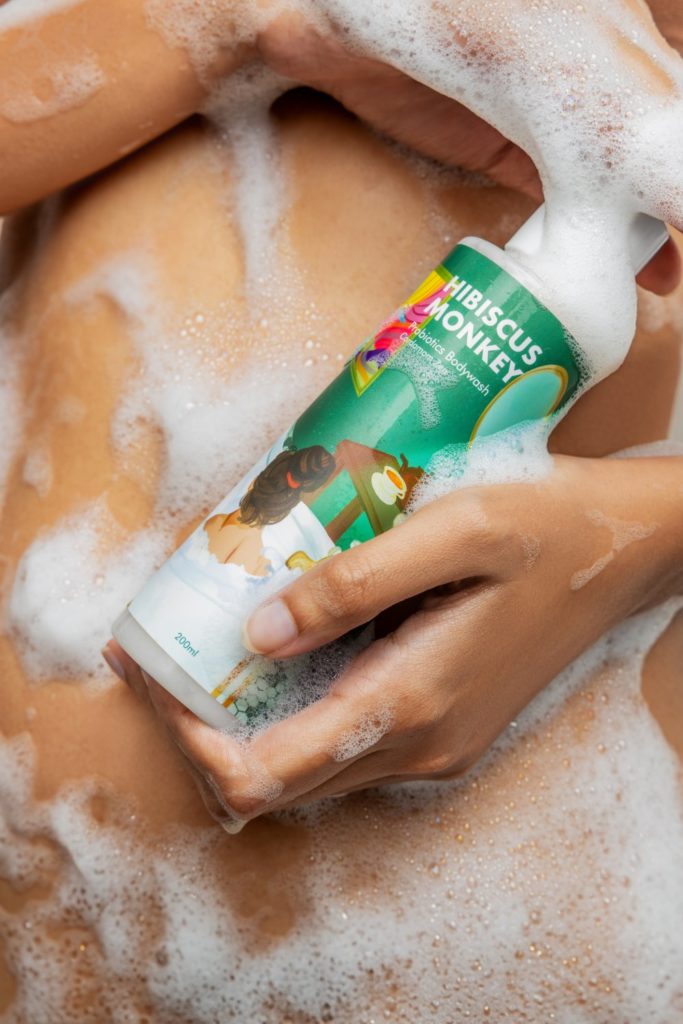
Cardamom Zen Probiotic Body Wash by Hibiscus Monkey is India’s first probiotic body wash, and it’s built around exactly this problem. It’s a 100% waterless concentrate, sulphate-free, alcohol-free, and contains no synthetic fragrance. It’s EWG-compliant and dermatologically tested. You can find it at hibiscusmonkey.com.
The formulation uses what Hibiscus Monkey calls a 3 Biotics SystemTM, a combination of pre, post, and biotic-adjacent ingredients designed to cleanse without triggering the microbiome disruption that conventional body washes cause.
The core ingredient is Lactococcus Ferment Lysate, which is a probiotic lysate. This is worth unpacking because a lot of products throw the word ‘probiotic’ around loosely. Live probiotic bacteria can’t survive in a rinse-off product, so Hibiscus Monkey uses a lysate instead: bioactive components derived from probiotic fermentation.
The lysate works by activating TLR-2 receptors in skin cells, which are part of the skin’s innate immune system and help maintain a balanced microbial environment on the skin surface. That’s a specific, documented mechanism, not just marketing language.
Inulin (from chicory) is the prebiotic in the system. Think of it as food for the good bacteria on your skin: it helps them survive and thrive on the skin surface. Yogurt Powder brings lactic acid and proteins that help keep your skin’s pH in that protective 4.5 to 5.5 range. And Beta Glucan supports the skin barrier by reducing water loss, because an intact, well-hydrated barrier is far less vulnerable to microbial imbalance in the first place.
How long does it actually take to see a difference?
This is a fair question, and I want to give you an honest answer rather than an optimistic one.
After washing with conventional soap, your skin microbiome can take anywhere from six to 24 hours to start recovering. When you’re washing daily, that means it’s essentially in a constant loop of disruption and partial recovery. Switching to a gentler wash breaks that loop, but the results build up gradually.
Most people report noticeable improvements in skin feel, less dryness and tightness, within two to four weeks of switching. Actual microbiome rebalancing, in terms of stabilising the populations of beneficial species, takes longer: researchers estimate four to eight weeks of consistent use. So don’t expect overnight results. Expect a gradual shift over a month or so, which for something as stubborn as body odour is actually a very reasonable timeline.
A few things that speed up the process: use warm water instead of hot (hot water strips more oil), keep showers shorter, and moisturise immediately after to reinforce your skin barrier while it’s rebalancing.
Frequently asked questions
Why do I still smell bad even though I shower every day?
Because body odour is produced by bacteria metabolising sweat, not by sweat itself. If your body wash is disrupting your skin microbiome with harsh surfactants, odour-producing bacteria may be repopulating faster than the beneficial species between each wash. Diet, stress levels, synthetic fabrics, and hormonal changes all also influence body odour independently of showering frequency.
What is the skin microbiome and how does it affect body odour?
The skin microbiome is the community of microorganisms living on your skin’s surface. A balanced microbiome keeps the skin’s acid mantle intact and limits the growth of odor-producing bacteria. When it’s disrupted, species like Staphylococcus hominis and Corynebacterium grow disproportionately, producing more of the volatile compounds that cause odour when they break down sweat.
Are sulphate-free body washes actually better for body odour?
They can be, yes. Sulphate-based surfactants like SLS and SLES raise your skin’s pH and strip the microbiome alongside the dirt, and odour-producing bacteria often repopulate faster than the beneficial species after that stripping. Sulphate-free formulas cleanse without that level of disruption, which gives your microbiome a better chance of staying balanced between washes.
What is a probiotic body wash and how is it different from a regular body wash?
A probiotic body wash uses ingredients derived from probiotic bacteria, usually as a probiotic lysate rather than live bacteria (live bacteria don’t survive in rinse-off products). The lysate interacts with skin receptors to support the skin’s immune function and microbiome balance. Cardamom Zen by Hibiscus Monkey, India’s first probiotic body wash, uses Lactococcus Ferment Lysate alongside a prebiotic (Inulin), Yogurt Powder, and Beta Glucan in its 3 Biotics System.
How do I know if my body wash is damaging my skin microbiome?
A few telltale signs: your skin feels tight or dry within an hour of showering, you’re noticing increased sensitivity or reactivity, your body odour hasn’t improved despite daily washing, or you get recurring irritation. If your skin consistently feels stripped right after cleansing, that’s a strong signal the surfactant system in your body wash is too aggressive for daily use.
The bottom line
Body odour is a microbiome problem, not a hygiene problem. And solving it starts in the shower, with what you’re using to wash.
If you’ve been fighting a losing battle with body odour despite showering every day, switching to a sulphate-free, microbiome-supportive wash is genuinely worth trying.
Give it four to six weeks of consistent use and pay attention to the gradual shift rather than expecting an overnight fix. Cardamom Zen Probiotic Body Wash by Hibiscus Monkey is India’s first probiotic body wash and is formulated specifically for this: sulphate-free, fragrance-free, with a 3 Biotics System that cleanses without stripping the microbial community your skin actually needs.